Revenue Cycle Automation · Payer Operations
How AI-Driven RCM Call Automation Eliminates Payer Call Burnout & Scales Claim Follow-Ups
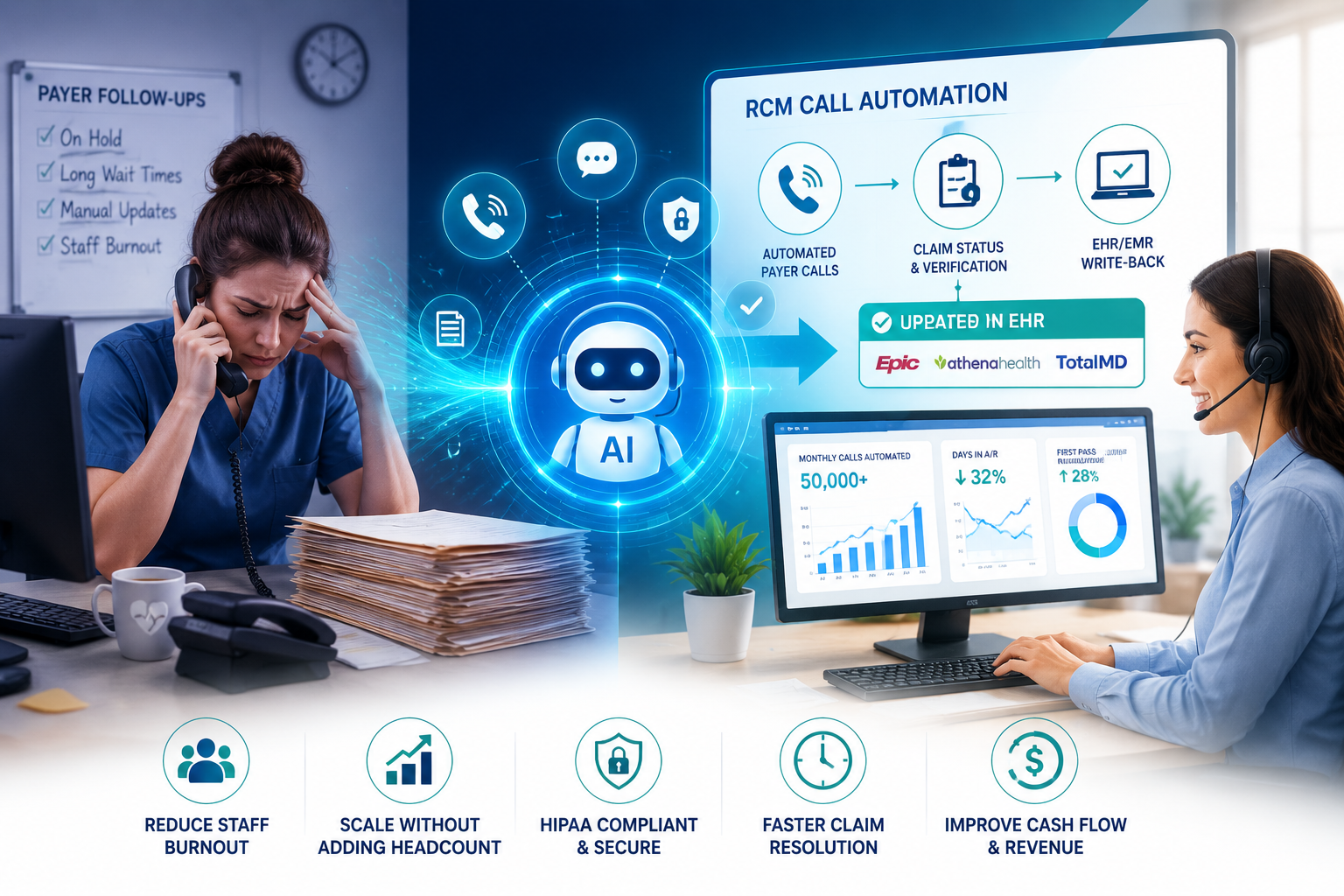
The Hold Queue, Visualized
AI-driven RCM call automation absorbs the hold-and-navigate work entirely — billers only step in when a call genuinely needs human judgment, not for every claim status check.
Ask any billing manager what's driving staff turnover on their team, and the answer rarely starts with pay. It starts with the phone. Claim status checks, eligibility verifications, and appeals follow-ups all funnel through the same bottleneck: a hold queue that doesn't care how many accounts are aging out.
This is the operational reality behind most healthcare revenue cycle management teams today — and exactly the problem purpose-built rcm call center solutions are designed to remove.
Section 01
The Hidden Cost of Payer Call Fatigue in Revenue Cycle Management
Initial claim denial rates climbed to nearly 12% in 2024 according to HFMA's most recent claims analysis — meaning for every 100 claims a practice submits, roughly a dozen bounce back and require a human to pick up the phone and chase them down. Each of those calls can mean 30, 45, even 90 minutes on hold before a biller reaches someone who can actually resolve the claim, and payer IVR trees are built to test patience, not save it.
The compounding pain points billing managers face every week:
- Staff turnover — repetitive, low-agency hold-queue work is one of the most cited reasons billing staff leave for other roles.
- Rising Days in Accounts Receivable (A/R) — nearly half of practices reported A/R days increasing year over year, and healthy AR benchmarks (under 40 days) are getting harder to hit manually.
- Rework costs that compound — each reworked claim costs an estimated $25–$181 in staff time, and roughly 60% of denied claims are never resubmitted at all, becoming permanent revenue loss.
- Scaling limits — adding call volume historically meant adding headcount, which most RCM teams and BPOs can't do fast enough to match payer-side friction.
Key Statistic: Industry surveys of billing operations consistently show staff losing a substantial share of the workday to hold queues and manual status checks — time that direct-dial automation can largely eliminate. For teams processing thousands of accounts a month, that's not a productivity footnote; it's the single biggest lever on both burnout and A/R days.
Traditional fixes — hiring more billers, faster call scripts, a second monitor for multitasking during hold time — treat the symptom, not the structural problem: a human is still required to sit on hold for a machine-driven phone tree. That's the exact task modern rcm call automation is built to remove entirely.
Section 02
How End-to-End RCM Phone Automation Solves the Scaling Challenge
RCM call center solutions built for healthcare don't just dial faster — they replace the entire manual hold-and-navigate workflow with a voice system that never gets tired, never gets transferred by mistake, and never forgets to log the call.
Automated Outbound Payer Inquiries at Scale (50,000+ Monthly Accounts)
Cloud-native voice automation can place and manage automated claim status calls across tens of thousands of accounts per month without adding a single seat to the billing floor. The system:
- Dials payer lines directly and navigates IVR phone trees automatically, including hold-queue detection and wait-out.
- Extracts structured claim status data (paid, denied, pending, additional-info-required) from both automated payer responses and live representative conversations.
- Prioritizes call volume by claim age, dollar value, and payer SLA — so the accounts closest to timely-filing deadlines get worked first.
- Escalates only the calls that genuinely require human judgment, instead of routing every call through a biller.
This is the difference between a healthcare call center that scales linearly with headcount and one that scales with infrastructure — a critical distinction for RCM teams and BPOs managing multi-client, multi-payer volume.
Deep EHR/EMR Write-Back Capabilities (Epic, TotalMD, Athenahealth)
Automation only closes the loop when the data actually lands where billers work. Leading rcm call automation platforms integrate directly with major EHR/EMR systems — including Epic, TotalMD, and Athenahealth — to write claim status results back into the patient account automatically, without a manual data-entry step. This creates:
- A real-time, always-current claim status field inside the EHR, instead of a spreadsheet that's stale by lunchtime.
- An automatic audit trail tied to each call, timestamped and linked to the account.
- Fewer duplicate follow-up calls, since staff can see at a glance which accounts were already worked that day.
Manual Payer Follow-Up vs. Automated RCM Call Agents
| Factor | Manual Follow-Up | Automated RCM Call Agents |
|---|---|---|
| Monthly call capacity | Limited by headcount | 50,000+ accounts, no added staff |
| Hold-time cost | Absorbed by billing staff, every call | Absorbed by automation, invisibly |
| Claim status logging | Manual entry, prone to gaps | Automatic EHR/EMR write-back |
| Call prioritization | First-in, first-out or ad hoc | Dynamic — by age, value, SLA |
| Audit trail | Inconsistent notes, easy to lose | Encrypted, timestamped, complete |
| Staff impact | High burnout risk, high turnover | Redirected to exceptions & appeals |
| Scalability | Requires hiring to grow volume | Scales instantly with volume |
The result isn't just fewer hours on hold — it's a measurable reduction in Days in Accounts Receivable and a higher first-pass resolution rate, because claims get worked sooner and more consistently instead of waiting for staff bandwidth to free up.
Section 03
Maintaining Strict HIPAA Compliance & Audit Trails
Scaling outbound call volume means nothing if it puts PHI at risk. Any hipaa compliant call center built for revenue cycle work has to treat compliance as infrastructure, not an add-on — because payer calls routinely involve verifying patient identity, diagnosis codes, and claim-level financial detail.
Technical compliance checklist for RCM call automation:
- BAA agreements & encrypted telephony — every call path, from dial to data storage, runs under a signed Business Associate Agreement with end-to-end encryption in transit and at rest.
- Secure IVR navigation — automated systems authenticate through payer IVR trees using the same verification standards a human agent would, without exposing PHI outside the encrypted call session.
- Audit logging for CMS & payer compliance — every call, outcome, and data write-back is logged with a timestamp and traceable record, ready for CMS or payer audit requests on demand.
- Automated escalation rules to human billers — any call that surfaces an appeal, a dispute, or an ambiguous payer response routes automatically to a human, rather than being auto-closed by the system.
This combination — encrypted infrastructure, complete audit trails, and clear escalation logic — is what separates a genuinely HIPAA-compliant healthcare call center from a generic outbound dialer repurposed for healthcare. For RCM teams and BPOs, it's also what makes automation defensible in front of compliance officers and payer audits alike.
Built for This Exact Workflow
RCM Contact runs every outbound payer call under a signed BAA, with encrypted telephony and full audit logging built into the platform by default.
Frequently Asked Questions
People Also Ask
Can automated RCM phone calls write back claim status data into Epic or TotalMD?
Yes. Modern HIPAA-compliant RCM call automation platforms feature direct EHR/EMR API integrations that write back real-time payer responses and log audit trails directly into patient accounts.
How does automated outbound calling scale to 50,000 monthly accounts?
By utilizing cloud-native voice bots that navigate complex IVR phone trees, hold on lines automatically, and capture structured payer responses without human agent intervention.
Is AI-driven RCM call automation actually HIPAA compliant?
It can be, provided the platform operates under a signed Business Associate Agreement, encrypts call data in transit and at rest, and maintains a complete, timestamped audit trail for every call and data write-back.
Does RCM call automation replace billing staff?
No — it removes the repetitive hold-queue and status-check work so billing staff can focus on exception handling, complex appeals, and payer negotiations that genuinely require human judgment, which typically improves retention rather than reducing headcount need.
What EHR and practice management systems does RCM call automation integrate with?
Leading platforms support direct integrations with major systems including Epic, TotalMD, and Athenahealth, along with API access for custom or less common EHR/EMR environments.
How does call automation reduce Days in Accounts Receivable?
By working claims sooner and more consistently — prioritizing outreach by claim age, dollar value, and payer filing deadlines — automated calling closes the gap between when a claim needs follow-up and when it actually gets worked, which directly compresses A/R days.
Is RCM call automation suitable for billing BPOs managing multiple healthcare clients?
Yes. Because automation scales with infrastructure rather than headcount, BPOs can absorb new client volume without a proportional hiring cycle, while maintaining per-client audit trails and compliance logging.
Get Started
Ready to eliminate hold times and automate claim status checks?
RCM Contact's HIPAA-compliant healthcare call center platform handles outbound payer calls, claim status checks, and EHR write-back at scale — so your billing team spends less time on hold and more time closing accounts.
Schedule a Live RCM Automation Demo →