Revenue Cycle Intelligence · Patient Scheduling
AI Predictive Analytics to Reduce Patient No-Shows: The 2026 Playbook for Private Clinics
How risk scoring, automated interventions, and empathetic AI voice outreach are turning empty exam rooms back into recovered revenue.
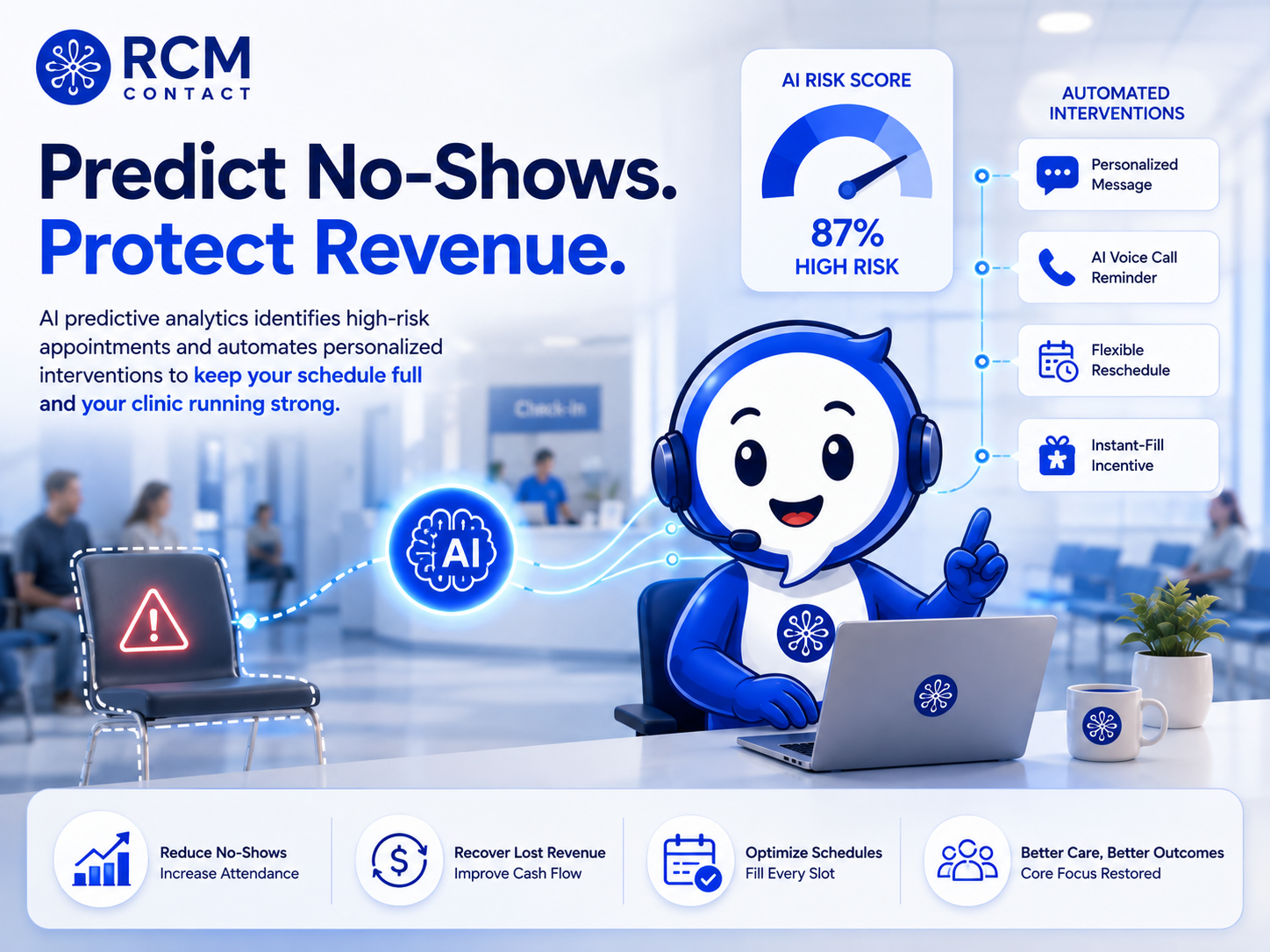
Every empty exam room in your clinic is a silent revenue killer that disrupts your entire medical team's workflow. What if you could see a no-show coming days before the patient ever calls to cancel? Clinics are now using AI predictive analytics to reduce patient no-shows — flagging high-risk appointments in advance and automatically triggering personalized interventions before an empty slot ever hits the schedule.
This is the shift from reactive scheduling to proactive, data-driven clinical management. Below, we break down exactly how it works, what's driving the 2026 no-show crisis, and how private practices are turning empty chairs back into recovered revenue.
Sample risk
score
Quick Answer
AI predictive analytics for patient no-shows is a scheduling technology that analyzes historical attendance data, patient behavior, appointment type, and external signals (like traffic and seasonal trends) to assign every upcoming appointment a real-time "risk score." High-risk appointments automatically trigger targeted interventions — personalized reminders, waitlist activation, or AI voice outreach — so clinics can act before a patient misses their visit, not after.
Stage 01 · The Problem
The Growing Crisis of Empty Waiting Rooms
No-Show Rates Are Climbing, Not Falling
Missed appointments have moved from a scheduling nuisance to a structural threat to clinic revenue. Industry reporting shows roughly a quarter of medical groups have seen no-show rates increase rather than decline in recent years, and outpatient no-show rates across specialties commonly range from 15% to 30% — with smaller independent practices frequently sitting near the higher end of that range. Inflation-driven patient financial stress, transportation gaps, and general scheduling friction are compounding the problem heading into 2026, making patient no-show prediction software less of a nice-to-have and more of an operational necessity.
The Hidden Financial Drain
The cost of a missed appointment goes far beyond the empty slot itself:
- Direct revenue loss — each missed visit can cost a practice roughly $200 in lost billing opportunity, and some independent clinics lose well over $100,000 annually to no-shows alone.
- Wasted staff overhead — front-desk and clinical staff are scheduled, prepped, and paid for a visit that never happens.
- Stagnant equipment ROI — imaging equipment, procedure rooms, and specialty devices sit idle instead of generating billable utilization.
- Downstream care gaps — missed visits delay diagnoses and follow-ups, which can ultimately increase the cost and complexity of care.
At the industry level, missed healthcare appointments are estimated to cost the U.S. healthcare system well over $150 billion every year — a number that makes reducing patient no-show rates a direct line item on any clinic's bottom line, not just an efficiency metric.
Why SMS Reminders Alone No Longer Work
Generic appointment reminders were once enough to move the needle. Today, they're background noise. Automated one-size-fits-all texts and robocalls treat every patient the same, regardless of why they're likely to miss a visit — whether that's forgetfulness, lack of transportation, cost anxiety, or simple scheduling conflicts. Because roughly a third of no-shows stem from patients simply forgetting, and a meaningful share from transportation or communication barriers, a blanket reminder strategy misses the actual root cause. This is exactly the gap that AI appointment scheduling for clinics is designed to close.
Stage 02 · The Shift
The Intelligence Shift: From Reminders to Predictions
How AI Assigns a No-Show Risk Score
Modern predictive analytics healthcare scheduling tools don't just remind patients — they predict behavior. Machine learning models are trained on years of appointment history, including:
- Past attendance and cancellation patterns
- Appointment type and time of day
- Patient demographics and communication preferences
- Distance from the clinic and travel patterns
- Payer type and out-of-pocket cost exposure
Each upcoming appointment is then assigned a dynamic no-show risk score in real time — allowing front-desk and outreach teams to focus effort exactly where it's needed instead of contacting every patient equally.
The Key Data Signals Driving 2026 Predictions
The newest generation of no-show models goes beyond patient history alone, layering in contextual signals such as:
- Local traffic and weather patterns that predict same-day cancellations
- Seasonal health trends, such as flu-season volume spikes or holiday scheduling gaps
- Cancellation velocity — how quickly and how often a specific patient has rescheduled in the past
- Communication responsiveness — whether a patient historically confirms via text, call, or doesn't respond at all
Some of the most advanced models built on this approach report prediction accuracy in the 90%+ range for identifying high-risk patients, a significant leap from earlier rule-based reminder systems.
Reactive Calling vs. Proactive Risk Management
The core shift is timing. Reactive systems call a patient the day before an appointment, hoping to confirm. Proactive AI predictive analytics for patient no-shows flags the risk days in advance — giving clinics time to intervene, rebook, or fill the slot through the waitlist long before the appointment window even opens. This single shift — from reminding to predicting — is what separates a modern scheduling operation from a legacy one.
Stage 03 · The Automation
Automating the Rescue Mission
Hyper-Personalized Interventions, Triggered Automatically
Once a patient is flagged as high-risk, the system doesn't just send another generic text — it triggers a specific, targeted action based on why that patient is likely to miss their visit. This might include a personalized reminder referencing their exact appointment details, a proactive rescheduling offer, or a direct outreach call addressing a known barrier. This is the operational core of any serious automated patient intervention software strategy.
Dynamic Scheduling: Overbooking and Instant-Fill Incentives
High-risk slots don't have to stay empty. AI-driven scheduling engines can:
- Strategically overbook appointment slots with the highest predicted no-show probability, similar to airline seat management
- Auto-notify waitlisted patients the moment a high-risk slot is identified, offering "instant-fill" incentives to claim the opening
- Rebalance the daily schedule in real time as risk scores update, rather than relying on static, once-a-day planning
Empathetic AI Voice Agents That Solve Real Barriers
Text reminders can't ask a patient why they're worried about a visit — but an AI voice agent can. Empathetic, conversational AI voice agents for patient scheduling can call high-risk patients directly to identify and resolve the actual barrier in real time: offering a telehealth alternative for transportation issues, connecting them with financial counseling for cost concerns, or simply finding a more convenient time slot. This is where predictive scoring becomes recovered revenue — the system doesn't just predict the problem, it resolves it.
Built for This Exact Workflow
RCM Contact pairs predictive risk scoring with automated appointment outreach across voice, SMS, and IVR — all inside a HIPAA-compliant platform built exclusively for healthcare revenue cycle teams.
Frequently Asked Questions
People Also Ask
How much revenue do private clinics lose to patient no-shows?
Missed appointments can cost an individual practice upwards of $100,000 per year, with each missed visit representing roughly $200 in lost billing opportunity. Across the U.S. healthcare system, no-shows are estimated to cost more than $150 billion annually.
What is a good patient no-show rate for a private clinic?
Independent practices commonly see no-show rates near 19%, while high-performing clinics using predictive scheduling and automated outreach have brought that number down to roughly 3–5%. Industry-wide, outpatient no-show rates typically range from 15% to 30% depending on specialty.
How accurate is AI at predicting which patients will miss appointments?
Modern predictive models trained on historical attendance, demographics, and behavioral data have demonstrated accuracy rates as high as 90%+ in identifying high-risk appointments, significantly outperforming manual staff judgment or generic reminder systems.
Can AI predictive analytics actually reduce no-show rates, or just predict them?
Both. Prediction is only the first step — the value comes from pairing risk scores with automated interventions such as personalized reminders, waitlist auto-fill, and AI voice outreach. Clinics using this combined approach have reported no-show reductions ranging from 20% to over 50%, depending on implementation.
Is AI-driven no-show prediction HIPAA compliant?
It can be, but only if the underlying platform is built for healthcare. A compliant solution should encrypt all patient data in transit and at rest, restrict PHI access to authorized staff, and operate under a signed Business Associate Agreement (BAA) — the same standard RCM Contact applies across its entire calling and outreach platform.
What causes most patient no-shows?
The leading causes include simple forgetfulness (roughly a third of cases), transportation barriers, cost anxiety, and poor communication from the provider's office — which is why generic, one-size-fits-all reminders are far less effective than personalized, risk-based interventions.
Does AI no-show prediction work for small or independent practices?
Yes. While large health systems were early adopters, cloud-based predictive scheduling and outreach platforms now scale down to 5–50 seat billing and clinical teams, since the risk-scoring models rely on appointment data patterns rather than practice size. Smaller clinics often see a faster relative impact because even a handful of recovered visits per week represents a meaningful revenue swing.
How long does it take to implement AI predictive scheduling in a clinic?
Most medical billing and clinical teams can be fully deployed within 2 to 4 weeks. This typically includes BAA execution, EHR or practice management integration, risk-model calibration against historical appointment data, and staff training on the automated outreach workflow.
Turn Empty Slots Into Recovered Revenue
See predictive outreach in action
RCM Contact brings predictive risk scoring and automated, HIPAA-compliant outreach to the entire revenue cycle — from appointment reminders to claims status IVR to patient payment collection.
Book a Free Demo →