HIPAA Compliant Call Center for Healthcare BPOs: Why Your Tech Stack Might Be Your Biggest Liability
Every healthcare BPO eventually hits the same wall: your agents are good, your process is tight, but the phone system underneath it all was never built for healthcare.
If you're running patient collections, eligibility verification, or denial follow-up for multiple provider clients on a generic contact center platform, you're not just risking inefficiency — you're carrying compliance liability that most operators don't realize is sitting on their books until it's too late.
The Hidden Risk in "Good Enough" Telecom Tools
Most call center platforms were built for retail, insurance, or general customer service — not for handling Protected Health Information (PHI) across dozens of provider clients with different payer mixes, compliance requirements, and state-level calling restrictions.
That mismatch shows up in a few predictable ways:
No Business Associate Agreement (BAA)
If your platform touches, stores, or transmits PHI during patient outreach or denial follow-up calls, HIPAA legally requires a signed BAA with your software vendor before a single call is placed. Many general-purpose dialers don't offer one at all — or treat it as a costly enterprise add-on negotiated after the fact.
No Claims-Specific Call Handling
Generic IVR and dialer tools aren't built around EOBs, claim statuses, or the reimbursement cycle. That means agents fall back on manual workflows and spreadsheets, which slows down denial resolution and increases the odds of a compliance misstep during a PHI-heavy call.
Multi-Client FDCPA and TCPA Exposure
BPOs calling on behalf of multiple provider clients face a compounding problem: every client may have different consent records, calling windows, and jurisdictional rules. A platform that doesn't automatically enforce FDCPA calling-time restrictions or track TCPA consent per contact puts every client relationship — not just one — at risk simultaneously.
The Bottom Line for BPOs: This isn't a theoretical concern. It's the kind of gap that shows up during a client audit, a patient complaint, or a regulator inquiry — at which point "we used a popular call center tool" is not a legal defense.
Why "Good Enough" Isn't Good Enough for Healthcare RCM
The core issue is that revenue cycle management isn't a generic outbound calling use case. It has its own workflows, its own compliance surface, and its own definition of a successful call — and that gap is exactly what a purpose-built platform is designed to close.
A HIPAA compliant call center for healthcare BPOs should be able to:
- ✓ Execute a comprehensive BAA with every client before deployment — not sell it as an enterprise upsell.
- ✓ Encrypt PHI and call recordings both in transit and at rest, strictly in line with the HIPAA Security Rule.
- ✓ Enforce FDCPA calling-time windows and contact-frequency limits automatically to prevent harassment claims.
- ✓ Track TCPA consent and opt-in/opt-out status accurately per patient, per provider client.
- ✓ Route RCM workflows — including claims status inquiries, eligibility checks, and payment collection — through systems built around the reimbursement cycle rather than a generic ticketing script.
Turning Compliance Into a Growth Lever
Here's the part most BPOs miss: closing this gap isn't just risk mitigation — it's a business advantage.
BPOs that can say "we run every call on a HIPAA-compliant, SOC 2 Type II audited platform with a BAA in place before day one" win larger provider contracts, pass vendor security reviews faster, and can quote turnaround times with confidence because their infrastructure doesn't slow denial resolution down.
That's the gap RCM Contact was built to close. Instead of retrofitting a generic dialer for healthcare use, BPOs get purpose-built infrastructure:
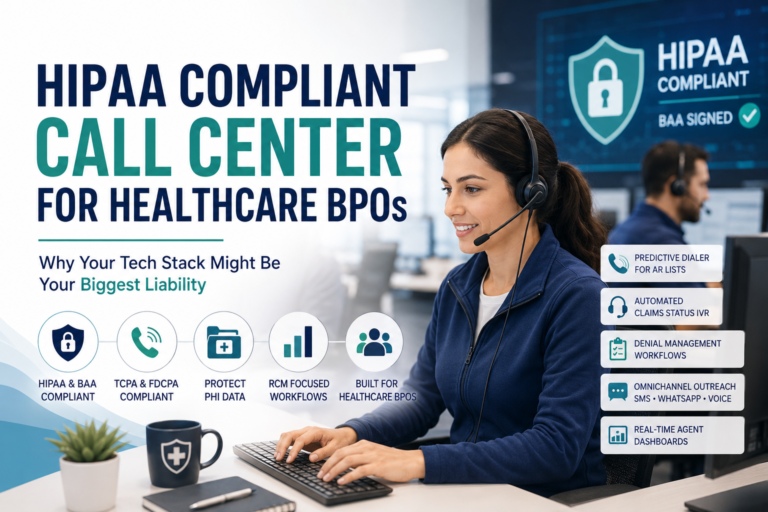
Predictive Dialer Built for AR
Connects agents only when a live patient answers, maximizing contact rates across large collections lists.
Automated Claims Status IVR
Deflects routine eligibility and claim-status inquiries so agents focus on high-value calls.
Denial Management Workflows
Dynamic scripts and payer data built around resolving denials, not generic customer service scripts.
Omnichannel Patient Outreach
TCPA-compliant SMS, WhatsApp, and voice reminders that automatically respect time-of-day restrictions by area code.
Real-Time Agent Dashboards
Gives BPO ops leads visibility into performance across every client account, ready for client reporting.
Open API EHR Integration
Bi-directional sync with Epic, Athenahealth, eClinicalWorks, AdvancedMD, and Kareo/Tebra to eliminate double data entry.
Signed BAA Executed Prior To Launch
Standard for every client engagement — no hidden enterprise add-on fees.
What This Looks Like in Practice
Picture a mid-sized healthcare BPO running patient collections and denial follow-up for eight provider clients. Today, that means eight sets of compliance requirements, eight payer mixes, and one overworked ops team trying to keep it all straight on a call center tool that wasn't designed for any of it.
With a Purpose-Built RCM Contact Center Layered In:
- ✓ Automated Client Segmentation: Segment patient balances and denied claims automatically by client account.
- ✓ Automated Compliance Enforcement: Run FDCPA- and TCPA-compliant outreach without manually tracking calling windows or local area code restrictions per state.
- ✓ Transparent Client Reporting: Hand each provider client a real-time performance dashboard instead of compiling labor-intensive manual reports.
The Strategic Result: It's not just fewer compliance headaches — it's the operational headroom to take on client #9 and #10 without adding compliance risk or headcount at the same rate as call volume.
HIPAA Compliant Call Centers for Healthcare BPOs: FAQs
Does my BPO need its own BAA with a call center software vendor, or does our client's BAA cover us?
If your platform touches, stores, or transmits PHI during outbound calling — which it does the moment an agent discusses a claim, balance, or patient detail — HIPAA requires your organization to have its own signed Business Associate Agreement with your software vendor, separate from any agreement your provider clients hold with their own systems. A BPO handling PHI on behalf of multiple clients needs vendor-level BAA coverage that applies across every one of those engagements, not just one.
How does a healthcare-specific platform reduce agent hold time compared to a generic dialer?
A generic dialer treats a payer hold the same as a dropped call. A platform built for RCM can flag when an agent is queued on hold with a payer, free that agent to work another call in the meantime, and alert them the moment the payer picks back up — instead of leaving a seat idle for the duration of a long hold. For BPOs running high call volumes across multiple clients, this kind of queue-aware routing directly increases the number of productive calls each seat can handle per shift.
Can a healthcare BPO manage TCPA compliance across clients in different states and time zones?
Yes — this is one of the harder problems generic call center tools don't solve. A platform built for multi-client healthcare outreach can evaluate a number's area code and time zone before dialing and automatically hold or abandon calls that fall outside permitted local calling windows, rather than relying on agents to manually track time zones across dozens of accounts. This matters more for BPOs than single-provider operations, since a BPO is running these rules simultaneously across every client on its roster.
How does automation reduce claims data entry errors during denial follow-up?
Manual entry of long alphanumeric claim or reference numbers is a common source of error in AR calling. Purpose-built platforms let agents pull that data directly from a spreadsheet or the client's own system into the call workflow, rather than retyping it, cutting a meaningful source of processing mistakes during high-volume denial follow-up.
Can BPOs scale agent seats up or down as client volume changes?
A cloud-based, purpose-built RCM contact center is typically usage-based rather than locked to a fixed number of agent licenses, so a BPO can add capacity for a new client contract or scale down between seasonal volume spikes without renegotiating a fixed seat commitment.
Does the platform support quality and compliance monitoring across multiple client accounts?
Voice analytics and call sentiment tools let BPO quality teams search recorded calls for specific phrases or flag negative patient sentiment automatically, rather than manually sampling calls. For a BPO managing compliance obligations across several provider clients at once, this kind of automated review is far more scalable than manual QA spot-checks.
Can this run under our BPO's own brand, or does it require exposing the underlying vendor to our clients?
Yes — a white-label deployment lets a BPO present the contact center as part of its own service offering, with performance dashboards and reporting built for the BPO to hand to its own provider clients, without the underlying technology vendor being part of that client relationship.
The Bottom Line
Healthcare BPOs don't need another generic dialer with healthcare "bolted on." They need infrastructure that was built around the reimbursement cycle from day one — compliance included, not upsold.
If your current contact center stack is holding your operation back from taking on more provider clients — or exposing you to compliance risk you can't fully quantify — it may be time to evaluate a platform built specifically for this work.
RCM Contact is purpose-built for healthcare revenue cycle teams and multi-client BPOs.
See how RCM Contact can plug directly into your existing operation, automate compliance, and accelerate your clients' AR recovery.